Showing posts with label Programming. Show all posts

Friday

// // Leave a Comment

Top Rated Computer Languages & Programming Books‎


C++ Learning Tutorial Urdu Book Download in PDF, Learn C++ in Urdu, Learning C++ Tutorial Urdu Book in PDFC++ is one of the most popular programming languages and is implemented on a wide variety of hardware and operating system platforms. As an efficient compiler to native code, its application domains include systems software, application software, device drivers, embedded software, high-performance server and client applications, and entertainment software such as video games.Several groups provide both free and proprietary C++ compiler software, including the GNU Project, Microsoft, Intel and Embarcadero Technologies. C++ has greatly influenced many other popular programming languages, most notably C# and Java. Other successful languages such as Objective-C use a very different syntax and approach to adding classes to C.C++ is also used for hardware design, where the design is initially described in C++, then analyzed, architecturally constrained, and scheduled to create a register-transfer level hardware description language via high-level synthesis.

Download and Read Online Urdu Computer Book C++ in Urdu pdf [Computer Books Urdu]


Head First Java 2nd Edition PDF Free Download


Java 2nd Edition PDF Free Download


Learn HTML In Urdu PDF Free Download


HTML Learning Tutorial Urdu Book Download in PDF, web developer need to start with html code. this book is for starting HTML with Introduction, HTML Editors, HTML Basic, HTML Elements, HTML Attributes, HTML Headings, HTML Paragraphs, HTML Formatting, HTML Links, HTML Head, HTML CSS, HTML Images, HTML Tables, HTML Lists, HTML Blocks, HTML Layout, HTML Forms, HTML Iframes, HTML Colors, HTML Colornames, HTML Colorvalues, HTML JavaScript, HTML Entities, HTML URL Encode, HTML Quick List, HTML Summary, HTML XHTML,
HTML is a computer language devised to allow website creation. These websites can then be viewed by anyone else connected to the Internet. It is relatively easy to learn, with the basics being accessible to most people in one sitting; and quite powerful in what it allows you to create. It is constantly undergoing revision and evolution to meet the demands and requirements of the growing Internet audience under the direction of the » W3C, the organisation charged with designing and maintaining the language.

Click Here To Download HTML Book Free


Head First PHP And MYSQL Books PDF Free Download


Head First HTML with CSS and XHTML PDF Free Download
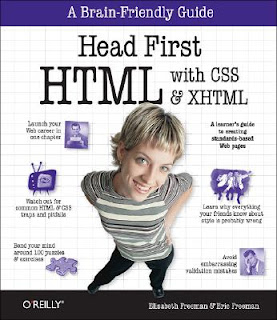


Free Download and Read Online Urdu Computer Book Html in Urdu (complete)


Corel Draw 15 in Urdu


Free Download and Read Online Urdu Computer Book Visual Basic 6 in Urdu Computer Learning pdf


Free Download and Read Online Urdu Computer Book MS Office 2010 in Urdu pdf


Free Download and Read Online Urdu Computer Book SEO in Urdu Complete Urdu Kitabain pdf


Read More

Thursday

// // Leave a Comment

Learn C and C++ (Programming Language + Tutorials)

This course will give an introduction to the programming language C. It runs in the autumn term and is addressed to students with no or little programming experience in C. Attending this course will enable you to write simple C/C++ programs and complete possible practical assignments of other courses that
run alongside this course. In this term, there will be no separate coursework assignments for the course
\Computing in C++".


  • Foundational C
  • C Vs. C++
  • Operators
  • Arrays and Strings
  • Pointers
  • Functions
  • Structures, Unions, Enumerations, and typedef
  • Console I/O
  • File I/O
  • The Preprocessor and Comments
  • The C99 Standard
  • The C Standard Library
  • String and Character Functions
  • Mathematical Functions
  • Time, Date, and Localization Functions
  • Utility Functions
  • Wide-Character Functions
  • Algorithms and Applications
  • Sorting and Searching
  • Queues, Stacks, Linked Lists, and Trees
  • Sparse Arrays
  • Expression Parsing and Evaluation
  • AI-Based Problem Solving
  • Software Development Using C
  • A C Interpreter
  • Compilers
  • Variables
  • Control Flow
  • Operators
  • Functions
  • Pointers
  • Structures
  • Advanced material


In 1997, Apple, in search of a solid base for a new next-generation operating system, purchased
NeXT. The NeXTstep OS was then used as the basis for Mac OS X, which saw its first
commercial release in early 2001; while libraries for compatibility with the old Mac OS line of
systems were included, AppKit and Foundation (by then known by the marketing name Cocoa)
formed the core of the new programming environment on OS X. NeXT’s programming tools,
Project Builder and Interface Builder, were included for free with every copy of Mac OS X, but
it was with the release of the iPhone SDK in 2008 that Objective-C began to really take off as
programmers rushed to write software for this exciting new device.


NSData and the Filesystem


@interface Employee : NSObject <NSCoding>
{
NSInteger employeeID;
NSString *name;
NSArray *currentProjects;
}
@end
@implementation Employee
-(void)encodeWithCoder:(NSCoder*)aCoder
{
[aCoder encodeInt:employeeID forKey:@"id"];
[aCoder encodeObject:name forKey:@"name"];
[aCoder encodeObject:currentProjects forKey:@"current projects"];
}
-(id)initWithCoder:(NSCoder*)aCoder
{
self = [self init];
if (!self)
return nil;
employeeID = [aCoder decodeIntForKey:@"id"];
name = [aCoder decodeObjectForKey:@"name"];
currentProjects = [aCoder decodeObjectForKey:@"current projects"];
return self;
}
@end
Any object can be used with NSCoder as long as that object also conforms to the NSCoding
protocol. All of the objects stored in the currentProjects array must also conform to this
protocol.


A Brief History of C
C was invented and first implemented by Dennis Ritchie on a DEC PDP-11 that used the Unix
operating system. C is the result of a development process that started with an older language called
BCPL. BCPL was developed by Martin Richards, and it influenced a language called B, which was
invented by Ken Thompson. B led to the development of C in the 1970s.
For many years, the de facto standard for C was the version supplied with the Unix operating
system. It was first described in The C Programming Language by Brian Kernighan and Dennis
Ritchie (Englewood Cliffs, N.J.: Prentice-Hall, 1978). In the summer of 1983 a committee was
established to create an ANSI (American National Standards Institute) standard that would define  the C language. The standardization process took six years (much longer than anyone reasonably expected).
The ANSI C standard was finally adopted in December 1989, with the first copies becoming available in early 1990. The standard was also adopted by ISO (International Standards
Organization), and the resulting standard was typically referred to as ANSI/ISO Standard C. In 1995, Amendment 1 to the C standard was adopted, which, among other things, added several new library functions. The 1989 standard for C, along with Amendment 1, became a base document for Standard C++, defining the C subset of C++. The version of C defined by the 1989 standard is
commonly referred to as C89.


High level
  • Ada
  • Modula-2
  • Pascal
  • COBOL
  • FORTRAN
  • BASIC
Middle level 
  • C++
  • C
  • Java
  • FORTH
  • Macro-assembler
Low level 
  • Assembler
http://adf.ly/d8yez


Read More

Earn 25$ Instant